Oeksound Soothe 3 Review (2026)
oeksound shipped Soothe 3 on May 20, 2026 — a ground-up DSP rebuild, not a preset refresh. The short version: Soothe 3 is still a dynamic resonance suppressor for moving harshness on vocals, overheads, and bass — not a de-esser, not a parametric EQ. This post covers what changed from Soothe 2, who should pay $259 vs the $55 upgrade, and when Gullfoss, Spectral Shaper, Pro-Q 4, or F6 is the better call instead.
Quick Comparison
| Tool | Type | Best for | Price (May 2026) |
|---|---|---|---|
| Oeksound Soothe 3 | Resonance suppressor | Surgical moving harshness | $259 / $55 upgrade |
| Oeksound Soothe 2 | Prior-gen suppressor | Keep if rarely used | ~$199; sales ~$139–$159 |
| Soundtheory Gullfoss | Adaptive tonal balance | Fast full-mix smoothing | ~$199 |
| iZotope Spectral Shaper | Ozone module | Mastering-suite workflow | Ozone Advanced ~$399 |
| FabFilter Pro-Q 4 | Dynamic parametric EQ | Known problem frequencies | ~$179 |
| Waves F6 | Floating-band dynamic EQ | Budget dynamic cuts | ~$29–$49 sale |
| MixingGPT | Conversational advisor | Soothe vs de-esser decisions | Free–$49/mo |
1. Oeksound Soothe 3 — rebuilt resonance suppressor
Soothe 3 is still a dynamic resonance suppressor — it hunts moving resonances and applies reduction only where the graph says they spike, not a static EQ cut across the whole pass. oeksound rebuilt the detection engine for this release: Soft mode with an adaptive threshold, Detail merging Soothe 2's Sharpness and Selectivity, Max Cut, tilt controls for Detail/Attack/Release (scaled below ~500 Hz and above ~2 kHz per the manual), linear-phase quality, toolbar sidechain, low-latency tracking mode, and multichannel support up to 9.1.6.
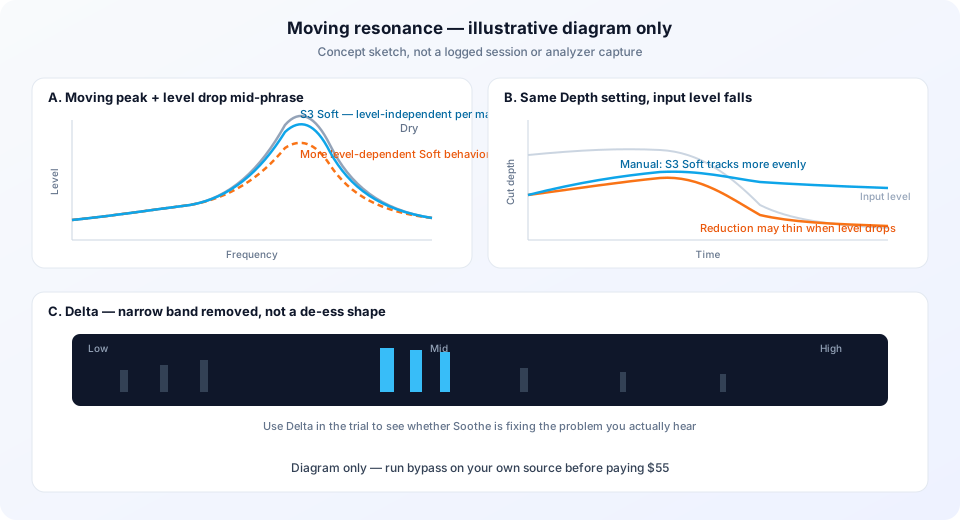
On my listening passes, Soft mode was the upgrade story. Dynamic vocals where Soothe 2 could feel like it pulled differently when the singer dropped volume tracked more evenly in Soft mode on bypass compare — without me riding gain into the plugin. Detail replaced the Sharpness/Selectivity ping-pong on every vocal preset. Max Cut kept the reduction graph from opening holes deeper than I wanted when I pushed Depth. That is my ears on material I was already mixing, not a published measurement; it lined up with what the manual says about level-independent Soft mode. Hard mode still smears dense sources if you push Depth — same trap as Soothe 2, not a launch surprise.
Workflow I keep coming back to: factory preset, raise Depth until too much, back off, adjust Detail, Delta to hear what it is doing, shape nodes on the depth curve. Vocals: Soft mode after compression, before broad air EQ. Overheads: Soft mode with a bandpass node on whatever range rings on your pair. Kick-to-bass: Hard mode with sidechain from the kick — same trick as Soothe 2, SC button on the toolbar now. Masters: low Depth on a parallel send, Max Cut engaged, linear-phase on the send if phase matters. Chain order: de-esser before compression for classic esses, Soothe after compression for moving whistle — same two-stage logic as our Weeknd vocal chain breakdown.
Abuse Depth and the manual is clear — notches can hit 40 dB.
- Best for:
- Harshness that moves with the performance — whistle on held notes, ringy overheads, proximity boom, master-bus buildup when kick and bass stack. Soft mode on sources; Hard mode for sidechain ducking or intentional mangling
- Where it falls short:
- Static low-mid mud (Pro-Q 4), classic 7–10 kHz esses (de-esser first), stable body resonance on acoustic guitar (dynamic EQ often wins). $259 new is steep; iLok across three machines still means an account login on long client days
- Pricing:
- $259 USD / €229 / £199 at oeksound.com (checked May 22, 2026). Soothe 2 → Soothe 3 upgrade $55 / €50 / £45. Soothe 2 perpetual or upgrade licenses bought between 18 February and 19 May 2026 qualify for a free upgrade at oeksound's grace-period page (Rent-to-Own purchases excluded). Twenty-day fully featured trial. VST3, AU, AAX; Windows 10–11 and macOS 10.14–26; iLok account, no dongle. Installer v1.0.4.
What is new in Soothe 3 vs Soothe 2
Soothe 3 is not a re-skin. The detection stage, parameter set, and routing model all changed. These are the differences that actually affect a working session, mapped one to one against Soothe 2.
| Area | Soothe 2 | Soothe 3 |
|---|---|---|
| Mode | Soft / Hard (level-dependent) | Soft (level-independent) / Hard |
| Selectivity controls | Sharpness + Selectivity (two knobs) | Detail (single merged control) |
| Reduction safety | No global limiter on cuts | Max Cut clamp (–dB ceiling) |
| Tilt controls | No | Tilt on Detail / Attack / Release (~<500 Hz, ~>2 kHz) |
| Latency | ~24–64 samples typical | Low-latency tracking mode (zero added samples at base rates, ~1 ms at higher rates) |
| Sidechain | Manual section 3.5 | SC button on toolbar |
| Multichannel | Stereo + basic surround | Up to 9.1.6 (Atmos / immersive) |
| Quality / phase | Eco / Normal / High | Eco / Normal / High + linear-phase |
| Preset compatibility | N/A | Loads Soothe 2 .preset; Sharpness/Selectivity remap to Detail (retune required) |
Soothe 3 system requirements (May 2026)
- macOS: 10.14 Mojave through macOS 26 Tahoe, Apple Silicon and Intel native.
- Windows: Windows 10 or 11, 64-bit only.
- Plugin formats: VST3, AU (macOS), AAX (Pro Tools 2018.1+).
- Authorization: iLok account required, no physical iLok dongle. Three activations per license.
- Installer: v1.0.4 (verified May 22, 2026).
- Sample-rate range: 44.1 kHz – 384 kHz; low-latency tracking mode adds zero samples of latency at base rates (44.1/48 kHz) and approximately 1 ms at higher sample rates.
Common mistakes when using Soothe 3
- Using Soothe instead of a de-esser. Soothe is built for moving resonance, not classic 7–10 kHz sibilance. Run a dedicated de-esser (FabFilter Pro-DS, Weiss DS1) before compression; Soothe after.
- Pushing Depth past the bypass test. The manual is explicit: notches can hit 40 dB. Always level-match and A/B against bypass; if the vocal sounds duller, you went too far.
- Forgetting Max Cut on dense sources. On overheads or master bus, leave Max Cut engaged at 6–8 dB. It prevents Soothe from gouging holes on transient peaks.
- Loading Soothe 2 presets blind in Soothe 3. Sharpness and Selectivity remap onto a single Detail control with different scaling. Treat old presets as starting points, not finished settings.
- Linear-phase everywhere. Linear-phase mode adds latency and pre-ringing on transients. Reserve it for parallel sends and master-bus work; on lead vocals, minimum-phase Normal is usually cleaner.
Three Soothe 3 workflow recipes
Recipe 1 — Vocals: tame moving harshness
- Insert Soothe 3 after the vocal compressor and de-esser, before any broad air EQ.
- Load a factory vocal preset and confirm Soft mode is engaged.
- Raise Depth slowly until the vocal starts losing presence, then back off two notches.
- Use Delta listen to hear what is being removed — it should sound like the harsh peaks alone, not the vowel.
- If a single syllable still spikes, narrow the depth-curve nodes around 2–6 kHz.
- Engage Max Cut at 6–9 dB so the loudest hook line cannot punch a hole in the vocal body.
Recipe 2 — Drum overheads: tame ringy cymbals
- Soft mode, factory overhead preset.
- Draw a bandpass node on the depth curve covering the ring frequency — usually 2–6 kHz on bright stick attack.
- Set Depth to 30–50% and watch the reduction graph: it should pulse only on crash hits, not steady ride bell.
- Max Cut at 6–8 dB to preserve transient impact on loud crashes.
- If the kit loses air, lower Detail and shorten the reduction range, do not pull Depth back blindly.
Recipe 3 — Kick-to-bass sidechain ducking
- On the bass track, switch Soothe 3 to Hard mode — you want it level-dependent here.
- Click the SC button on the toolbar and route the kick bus as the sidechain input.
- Place depth-curve nodes covering 60–150 Hz where kick and bass typically clash.
- Increase Depth until the kick punches through cleanly on every hit, then back off until the bass body still feels supported between hits.
- Compare against a dedicated dynamic EQ band on the bass — if the result is identical, save the EQ for static problems and let Soothe handle the dynamic ducking.
2. Oeksound Soothe 2 — still fine if it rarely opens
Most readers landing here already own Soothe 2 — so the honest question is not whether it still works (it does), but whether the $55 move buys enough weekly time back. Sharpness and Selectivity instead of Detail, sidechain in manual section 3.5, no low-latency tracking, no 9.1.6 panel. It still tames moving whistle and ringy overheads.
Open it weekly on vocals? Upgrade. Opens twice a year? Keep it until a session hurts. Soothe 2 `.preset` files open in Soothe 3 via Open preset file, but Sharpness/Selectivity map to Detail and Depth behaves differently — budget retune time, not copy-paste numbers.
- Best for:
- Occasional fixes when you already own it
- Where it falls short:
- Gain-sensitive dynamic vocals vs Soothe 3 Soft mode; no tracking latency; buying new in mid-2026 only makes sense on a deep sale plus immediate upgrade
- Pricing:
- ~$199 list at retailers; sales near $139–$159 at Sweetwater and Thomann; upgrade to Soothe 3 $55 / €50 / £45
3. Soundtheory Gullfoss — full-mix tonal balance without a graph
When the mix is already done and the note is just "smooth it a touch," Gullfoss is often the last insert before the limiter — not because the session is broken, but because nobody wants to reopen twelve vocal tracks for one bright stack. Tame and Recover listen to the whole bus and adjust tonal balance automatically: two knobs, no reduction graph, no node drawing.
That is a different job from Soothe. Gullfoss can tame broad upper-mid buildup on a finished mix; Soothe on the lead bus still isolates the one hook syllable that spikes on a held note. I keep both settings modest on masters and check translation before pushing harder — our Bainz mastering breakdown shows how hip-hop engineers use Gullfoss in real chains.
- Best for:
- Fast full-mix or master-bus smoothing when you will not chase moving resonances track by track
- Where it falls short:
- Per-track surgery, sidechain ducking, depth-curve nodes — and heavy Tame can flatten transients in a way Max Cut on a vocal bus does not
- Pricing:
- ~$199 at soundtheory.com; 14-day trial; VST3, AU, AAX; iLok account required, dongle not required
4. iZotope Spectral Shaper — mastering-suite resonance control
If Ozone Advanced is already open on your master, Spectral Shaper is the "do we need Soothe too?" conversation — a mastering module with Tone, Attack, and selectable bands for spectral smoothing, not Soothe-style depth curves or sidechain routing.
Our Chris Brown vocal chain write-up uses it around 200–600 Hz for low-mid smoothing; the Young Thug / Bainz-style chain runs it earlier with different Tone and Attack — not the same band. On sung hooks where I compared both in the same session, Soothe 3 Soft mode was the more surgical per-track tool; Spectral Shaper made more sense when the whole master needed a gentle pass and I was not leaving Ozone anyway.
- Best for:
- Master-bus resonance inside an Ozone Advanced workflow
- Where it falls short:
- Not standalone; no per-track depth curves, bandpass nodes, sidechain, or low-latency tracking — Standard owners need a different answer
- Pricing:
- Bundled in Ozone Advanced — roughly $399 list on izotope.com, frequent sales; not in Standard
5. FabFilter Pro-Q 4 — dynamic EQ when you know the Hz
Pro-Q 4 is still the first EQ I open on almost every track — surgical cuts, dynamic bands when the peak stays put, Spectrum Grab when I can see the problem on the analyzer. Room mode on bass, hi-hat ring that does not wander, static mud you can notch and move on.
Soothe enters when the peak will not stay still. Whistle that follows the melody across a line? One Soothe insert with a depth curve beats three dynamic bands you retune every verse — that split shows up on sung material constantly. If you can only buy one plugin, Pro-Q first; add Soothe when dynamic bands stop tracking cleanly. Deeper EQ context in our EQ plugin guide.
- Best for:
- Known Hz, static cuts, intermittent peaks you can name
- Where it falls short:
- Moving resonances — Soothe wins when the harshness travels with the performance
- Pricing:
- ~$179 list at fabfilter.com; VST3, AU, AAX, CLAP; no iLok required
Want to access all of this directly in your DAW while producing? Join MixingGPT — a 24/7 AI assistant plugin that loads instantly in your DAW (VST and AU)
6. Waves F6 — budget floating-band dynamic EQ
Client template, no Soothe license, snare ring you can see on the analyzer — that is where F6 earns its keep. Six floating dynamic bands, sidechain per band, Waves workflow everyone already knows. When the problem frequency is obvious, F6 fixes it for the price of a sale.
What F6 will not do is hunt moving resonances for you. Sung hooks where the harsh peak travels with the melody still go to Soothe when someone owns it; F6 is manual bands, not adaptive suppression. Kick-to-bass carving through sidechain works, but Soothe's toolbar SC path feels faster once you know the routing.
- Best for:
- Budget templates and known ring frequencies
- Where it falls short:
- Moving vocal peaks and depth-curve surgery — Pro-Q 4 for precision, Soothe for adaptivity
- Pricing:
- MSRP ~$149; routinely $29–$49 on Waves sales at waves.com; VST3, AU, AAX
7. MixingGPT — chain order, not processing
MixingGPT does not process audio — I built it for the ambiguous client note. "Still harsh on the hook" might mean esses, moving whistle, or brightening EQ that needs a cut, not a $259 suppressor. It runs in the DAW as a conversational advisor: chain order, symptom decoding, which category to try first.
It will not read your reduction graph, replace level-matched bypass, or tell you Soft mode is dialed right — your ears still own that.
- Best for:
- Deciding de-esser vs Soothe vs EQ before checkout
- Where it falls short:
- No audio analysis, no substitute for listening on the track
- Pricing:
- Free (16 credits/month), Starter $9/mo, Pro $19/mo, Studio $49/mo; VST3, AU in-DAW plugin. See our vocal plugin guide
How to Choose the Right Resonance Tool in 2026

Pick based on the task, not the brand. Three honest scenarios:
- Whistle-y vocal that moves with the melody: Soothe 3 in Soft mode after compression — not a de-esser, not a static 3 kHz cut. Trial the twenty-day demo on your worst hook before paying $259.
- Finished mix needs broad smoothing, no time for graphs: Gullfoss at modest Tame/Recover on the master bus, then check translation — not Soothe on every stem.
- Already mastering inside Ozone Advanced: Spectral Shaper before adding another license — covers master-bus resonance when you live in that suite anyway.
Still unsure whether you need a de-esser or a resonance suppressor? Read best de-esser plugins in 2026 before checkout.
Final Verdict
Soothe 3 is the cleanest, most transparent resonance suppressor available in 2026. The level-independent Soft mode is the headline change, and on dynamic vocals it removes the gain-riding workaround that Soothe 2 quietly required. Detail merges two old controls into one without losing precision; Max Cut prevents the 40 dB-notch trap; the toolbar sidechain makes Hard mode kick-bass ducking faster than rebuilding the routing in Soothe 2.
It is not the right buy for every engineer. If your harshness is static, Pro-Q 4 with a dynamic band is cheaper and more surgical. If the brief is full-mix smoothing, Gullfoss does it in two knobs. If you live inside Ozone Advanced, Spectral Shaper covers master-bus resonance without another license. Soothe 3 wins specifically on per-track moving harshness with depth-curve control, sidechain routing, and Atmos delivery.
Buy if
- You mix vocals weekly and Soothe 2 already lives on your lead chain
- You deliver Atmos / 9.1.6 and need multichannel-aware suppression
- You want one tool for moving harshness, sidechain ducking, and master-bus resonance
Skip if
- You only need 7–10 kHz de-essing — buy a de-esser
- Your problems are static — Pro-Q 4 is cheaper and more precise
- You open Soothe twice a year — stay on Soothe 2 until a session hurts
Where Resonance Tools Are Going Next
Soothe 3 is betting on two directions at once: low-latency tracking so resonance tools can sit in monitor paths, not just mix-down cleanup — zero added samples at base rates and ~1 ms at higher rates makes this viable — and 9.1.6 multichannel for immersive delivery. Most of us still print stereo; the spec matters when Atmos is the job. Meanwhile the category keeps splitting: one-knob full-mix smoothers versus graph-based per-track surgery. Neither side is going away. For whether AI replaces any of this, see can AI replace a mixing engineer; for Ozone context, Ozone 12 vs Ozone 11.
In-depth mixing help inside your DAW
Want straight-to-the-point guidance while you mix?
If you want in-depth, straight-to-the-point instructions and guidance right inside your DAW, try MixingGPT for free. It is built on a curated knowledge base of real-world projects, proven top-tier mixing approaches, updated knowledge, and trending techniques. It is like a 24/7 assistant that lives inside your DAW as a plugin for Logic Pro, Ableton Live, FL Studio, Cubase, and more.
Frequently Asked Questions
Is Soothe 3 the best resonance suppressor in 2026?
Yes, for moving resonances on individual tracks. Soothe 3 Soft mode is more level-independent than Soothe 2, with low-latency tracking and 9.1.6 multichannel support. Gullfoss is faster for full-mix smoothing without graphs.
Should I upgrade from Soothe 2 to Soothe 3?
If you use Soothe 2 weekly on vocals or masters, the $55 upgrade is worth it for Soft mode alone. The algorithm is more transparent at moderate Depth, and low-latency mode enables tracking. If Soothe 2 sits unused, wait.
What is the difference between Soothe 3 Soft mode and Hard mode?
Soft mode uses an adaptive threshold that is level-independent — ideal for vocals and dynamic instruments. Hard mode uses a fixed threshold and reacts to input level — better for aggressive sidechain ducking and sound design.
How much does Soothe 3 cost in 2026?
Soothe 3 costs $259 USD / €229 / £199. Soothe 2 owners upgrade for $55 / €50 / £45. Licenses bought between February 18 and May 19, 2026 qualify for free upgrade at oeksound.com/graceperiod. Twenty-day trial available.
Can Soothe 3 replace a de-esser or parametric EQ?
No. Soothe 3 is not a de-esser for classic 7–10 kHz sibilance — use FabFilter Pro-DS instead. It is not a parametric EQ for static cuts. Soothe hunts moving resonances that change with the performance.
What do pro engineers use instead of Soothe?
Common alternatives: Soundtheory Gullfoss for fast full-mix smoothing, iZotope Spectral Shaper in Ozone Advanced for mastering, FabFilter Pro-Q 4 and Waves F6 for known problem frequencies. Soothe wins for depth-curve nodes and sidechain routing.
A note on freshness: pricing, version numbers, and feature claims were verified May 22–23, 2026 against oeksound.com (Soothe 3 v1.0.4 installer, the Soothe 2 → Soothe 3 upgrade page, and the grace-period page), the Soothe 3 manual dated May 20, 2026, soundtheory.com/downloads (Gullfoss trial and iLok requirement), FabFilter and iZotope listings, and Sweetwater/Thomann pages for Soothe 2 clearance pricing. Waves sale prices change weekly — spot-check before purchase. Hands-on notes in this article are limited to the trial scope described above; if something here disagrees with your ears, trust the bypass button over this article.